
Effortless Load Carrier Management: JACOB Relies on Smart Interaction Between Trackers and Software
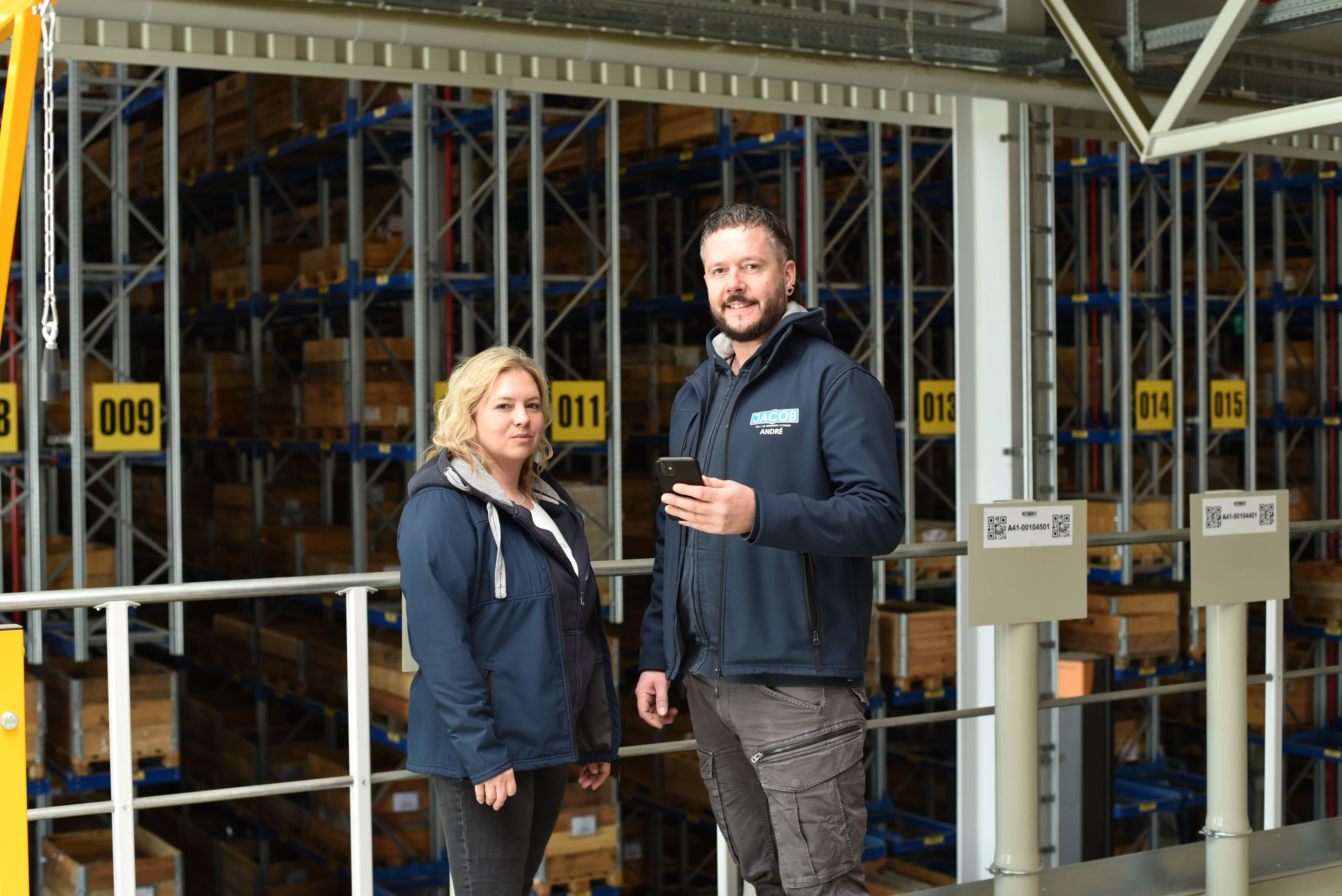
In order to automate the management of pipe racks, Fr. JACOB Söhne GmbH & Co. KG has successfully tested a digital system for tracking load carriers in collaboration with Logistikbude GmbH. The pipe specialist plans to implement it in other processes in the future. With the help of Bluetooth Low Energy (BLE) trackers, barcodes, and gateway points on the factory premises, employees can track exactly where their pipe racks were last located and when they will arrive again. This facilitates communication between manufacturing partners, increases transparency, and prevents load carriers or associated orders from getting lost.

Customized pipe systems based on a modular design principle – that is the concept behind JACOB. With 100 years of experience, around 600 employees, and five international locations, the company is one of Europe's leading manufacturers of modular pipe systems. From conveyor pipe systems for bulk material handling and low-pressure conveying to dust extraction and exhaust air systems for environmental technology, the pipe specialist from Porta Westfalica offers numerous solutions for a wide range of applications, both as series production and in the form of customized special designs.
Traditional order forms and lost load carriers
JACOB offers a wide range of large components and tiny custom-made parts. Numerous load carriers are used both within the company and for delivery to manufacturing partners, external assembly companies, or customers to transport pipes, butterfly valves, or clamping rings from A to B. Depending on the goods, different pallet variants, metal boxes, or special pipe racks are used for this purpose. Andre Hayden, Pre-Production Forming Team Coach at JACOB, struggled with missing load carriers in day-to-day operations. This was particularly problematic with small parts in large quantities.
“If a pallet containing 5,000 tension rings is lost along the supply chain, this immediately results in shrinkage costs running into the thousands—and the customer waits in vain for their goods,” Hayden summarizes.
The system used to manage load carriers until the end of 2024 was confusing. Orders were recorded manually in a list and color-coded according to status: This was intended to show whether products and load carriers were still on the company's premises, at the customer's premises, or, for example, still at the electroplater's. There, the metal surfaces of the goods are coated and made corrosion-resistant before being returned to JACOB and finally transported from there to the customer. However, obtaining information on the whereabouts of the goods proved difficult in everyday work.
“We work with traditional order slips, which we attach to the front of our metal boxes for transport,” explains Hayden. “We cannot tell from the slips alone when and whether the load carriers will leave our premises, to what extent they will be returned, and where they will be stored again at our site.”
Occasionally, orders were unintentionally combined and consolidated by manufacturing partners and returned to JACOB, which made it difficult to keep track of them. Although missing orders usually reappeared, this involved considerable delays and extremely complex processes.
“To find a single metal box, we spent half a working day contacting numerous partners by phone,” adds Hayden.
Finally, contact with Logistikbude was established at a trade fair: Tobias Werner, Head of Business Transformation at JACOB, visited their booth and became aware of their software solution, which completely digitizes load carrier management. Other departments were also very interested in restructuring the management of boxes and racks. Hayden and Werner then contacted Logistikbude to initiate the change process and take the first steps toward digitized load carrier management.
.jpg)
Trackers, barcodes, and fixed transmission points enable digital location tracking
Together, they launched a seven-month pilot project in which they implemented the load carrier management solution at two JACOB partners. The aim was to make the racks digitally visible when they left the factory premises and when they arrived there, so that the status of the order could be tracked. To this end, the Logistikbude team equipped a total of 20 pipe racks with so-called BLE trackers. These thumb-sized devices use Bluetooth Low Energy, a technology for wireless communication over short distances. In addition, the test racks were given a sticker with a barcode that links the tracker and the rack.
In order to track exactly when these racks leave the factory premises or are returned there, JACOB and Logistikbude brought another partner on board: Robert Bosch GmbH. The leading international technology and service company provided so-called gateways for the project, which were installed at specific points on the JACOB factory premises. This created fixed transmission points both at the staging tent and in the goods receiving and shipping hall. When a load carrier passes these transmission points, for example when leaving the factory premises, the gateways automatically send a signal. This allows the Logistikbude software solution to record the position of the load carriers and thus also confirm when they have been returned.
When a new order comes in, a traditional order form is still created and the goods are bundled on a load carrier. JACOB employees scan the barcode using the app version of Logistikbude on their cell phone and link the order to the respective rack, which is then taken to the electroplater. When it comes back, employees can see its location in the web-based software with an accuracy of up to 6 meters. They use the app to scan the barcode again to confirm the return. They can also note whether any load carriers have been damaged and need to be replaced.
Werner explains: “Thanks to the software from Logistikbude, we not only know when our racks will be returned, we can also see exactly how many load carriers are currently available for deliveries.”
Overall, however, the solution impresses above all with its simplicity, clarity, and user-friendliness.
“The software is so intuitive to use that it hardly needs any explanation. This means our employees can start using it right away,” says Werner.
The software has also fundamentally changed the exchange of information about the whereabouts of the load carriers:
“Communication is faster, more direct, and easier to follow—this boosts our productivity enormously,” he adds.
.jpg)
Open, honest, forward-looking
Following the successful test phase with partner companies, the new system is now to be implemented for external deliveries to end customers in order to make load carrier management even more efficient. In the future, a connection to the existing SAP system and a changeover of pallet management within the JACOB factory premises are also conceivable.
Hayden sums it up: “We enjoyed working with Logistikbude because we communicated openly and honestly and had a lot of fun doing so. The personal exchange contributed significantly to the success of the project – we are looking forward to the next steps.”
Photographer: Lucas da Costa

Schedule a free consultation now!
We would like to get to know you and your current challenges with reusable objects. As a first step, we analyse your status quo together and check where there is potential for optimization and automation. If we have a suitable solution for you, we will present our solution to you on your use case in a second appointment.
