
Why Your WMS, TMS, and ERP Cannot Save Your Load Carriers – and Which System Closes the Gap

Does this sound familiar?
You have a WMS. You have a TMS. Plus an ERP, document management, and much more. And yet: pallets, containers, racks, and the like disappear, accounts don't balance, and at the end of the month, the big guessing game begins. How many load carriers are actually out there? Who owes us how many? And why isn't it right again?
The sobering answer: Because WMS, TMS, and ERP simply weren't built for load carriers. And those who don't understand this lose money every day – quietly and steadily.
In this article, you'll learn why load carriers always fall through the cracks, what a Load Carrier Management System (LCMS) truly accomplishes – and what costs you're missing out on every month as long as you don't use one.
The underestimated problem: Pallets don't disappear – they're booked incorrectly (or not at all)
Most people associate pallet loss with theft – a driver grabbing a pallet and putting it in their trunk. In practice, however, that's the exception. The real enemy is accounting-related.
Typical real-world scenarios:
- Quality discrepancies: You send out A-grade quality and get C-grade quality back. The difference in value? Up to 10 Euros per pallet. With hundreds of thousands of units annually, this adds up to massive losses – without anyone physically stealing anything.
- Missing bookings: The classic scenario – 32 pallets are loaded, but 2 extra for load securing are added and never booked. Sounds like a minor issue? With 100 trucks per day, you lose several hundred Euros daily.
- Lack of validation: Anyone who manages an account "somehow" – 10 in, 5 out – has no proof whether the numbers are correct. Without proper reconciliation with business partners, no one knows if anything is actually missing.
What really helps: Double-entry bookkeeping. Just like in accounting. If you receive 10 pallets, your inventory increases by 10 – and simultaneously, a liability for 10 pallets is created. The total quantity in the system remains constant. Every discrepancy becomes immediately visible. That's exactly how a robust LCMS works.

The 3 cost drivers that almost no one is aware of
Loss is what you see. But the real costs lie elsewhere:
1) Capital tie-up costs
If Spedition Müller owes you 1,000 pallets, you've just given them an interest-free loan. Example calculation: With a pallet price of €10 and 2% interest over half a year, that quickly amounts to €10,000 in opportunity costs – quietly lost. Additionally, there's the default risk: If the business partner goes bankrupt, the pallets and the capital are gone. Especially in economically challenging times, liquidity is not a nice-to-have.
2) Excess Stock Due to Lack of Transparency
You have pallets – but you don't know where they are. So you reorder. Your warehouse fills up with stock you already own. Excess stock ties up capital and incurs storage costs – for goods that are sitting somewhere with a partner and simply haven't been accounted for.
3) Hidden Labor Costs
In large logistics service providers, there's a clear department: pallet accounting. These are direct, visible costs. In manufacturing companies, however, this task is spread across dozens of people: the forklift driver records goods receipts, production sends an email in the evening about empties, the dispatcher clarifies discrepancies by phone. No one is dedicated to this topic full-time – and that's precisely why it slips through all controlling checks. Experience shows that 3–5 hours per week per employee are spent on this issue. With five people, this adds up to over 100 hours per year – just for searching and reconciling.

Why WMS, TMS, and ERP Don't Solve the Problem
It sounds simple in theory: "We'll just record it in the WMS." In practice, this fails for two reasons:
First: Too many systems, too little consolidation. A single pallet movement already touches three systems: the ERP records the order, the WMS captures goods receipt and picking, and the TMS completes the transport. And this is in a company that isn't even particularly complex. In reality, there are company acquisitions, multiple locations, and historically grown system landscapes. A service provider, for example, operates over 400 different WMS instances – one per client. A feature module in the WMS does not solve the fundamental problem.
Second: These systems think linearly – an LCMS must think in terms of networks. WMS, TMS, and ERP map processes with a clear start and a clear end: order in, picking, delivery – done. This is like a parcel tracking system in e-commerce: linear, from A to B.
Load carriers function differently. They flow through a network, creating liabilities and claims between dozens of partners, leaving your own premises, changing hands, returning – or not. This is more akin to the flow of money in banking than a transport order. And WMS, TMS, and ERP are simply not designed for this.
What an LCMS Truly Delivers – and Why It's a Category of Its Own
A Load Carrier Management System is not a feature that you integrate into a WMS. It is a dedicated system with two core tasks:
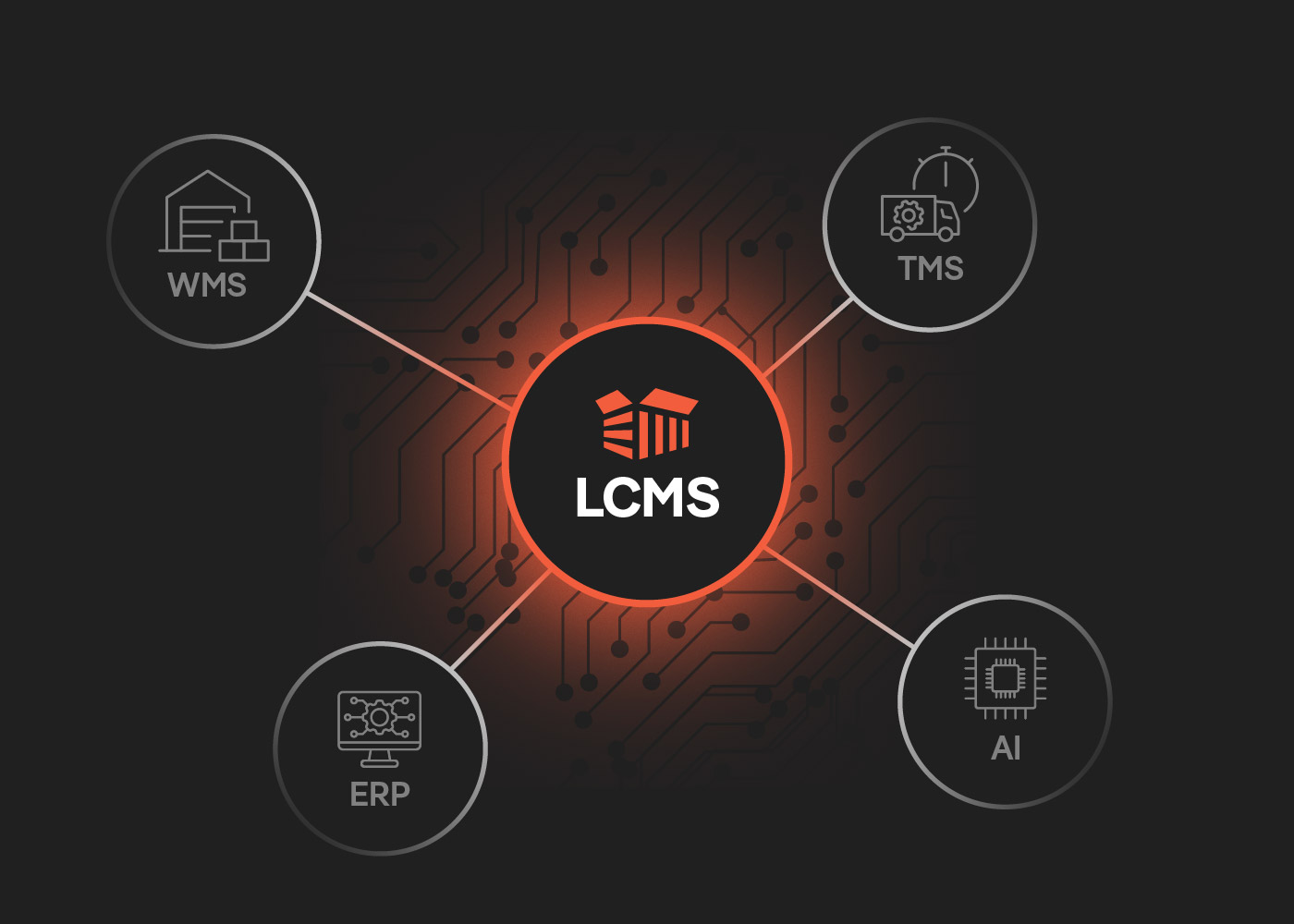
- Single Point of Truth for all load carriers: All relevant data points – from ERP, WMS, TMS, mobile apps, IoT devices – converge. You see at any time and in real-time who has how many load carriers, for how long, what value this ties up, and how high the risk of loss is.
- Automation of load carrier processes: No one manually enters quantities anymore. Account reconciliations run automatically, pallets are automatically reordered, invoices are automatically checked, and registrations and deregistrations with the pooler are automatically triggered. Even the settlement of claims – Lisa still owes you 5,000 pallets, an invoice is automatically generated at the end of the month – runs without manual intervention.
Key Benefits at a Glance
✔ Up to 80% less labor effort through automated booking and reconciliation
✔ Real-time dashboard: Who owes you how many load carriers – and since when, including corresponding alerts
✔ Reduce shrinkage by up to 90% because discrepancies become immediately visible
✔ Reduce capital tie-up costs: identify receivables, automatically settle, convert into cash
✔ Partner integration without system access – simply via weblink
✔ No system change necessary – the LCMS connects what already exists. Established processes remain in place
Conclusion: Anyone who takes load carriers seriously needs a system that understands them
WMS, TMS, and ERP are powerful systems – for what they were built for. Load carriers fall through the cracks because they don't function like goods, transports, or accounting entries. They flow through networks, generate receivables and liabilities, and leave the company's premises.
An LCMS closes precisely this gap: It brings together existing data points, fills in the gaps, automates load carrier-specific processes, and thus creates a complete overview for the first time – in real-time, for all involved parties.
The result: less shrinkage, less personnel effort, less tied-up capital – but significantly more control.
____________________________________________
Logistikbude is the first Load Carrier Management System (LCMS) for the automatic management of pallets, containers, racks & co. . Like a pair of glasses, the LCMS overlays existing IT infrastructures as an intelligent data layer, making scattered data fragments transparent and usable.

Schedule a free consultation now!
We would like to get to know you and your current challenges with reusable objects. As a first step, we analyse your status quo together and check where there is potential for optimization and automation. If we have a suitable solution for you, we will present our solution to you on your use case in a second appointment.
